
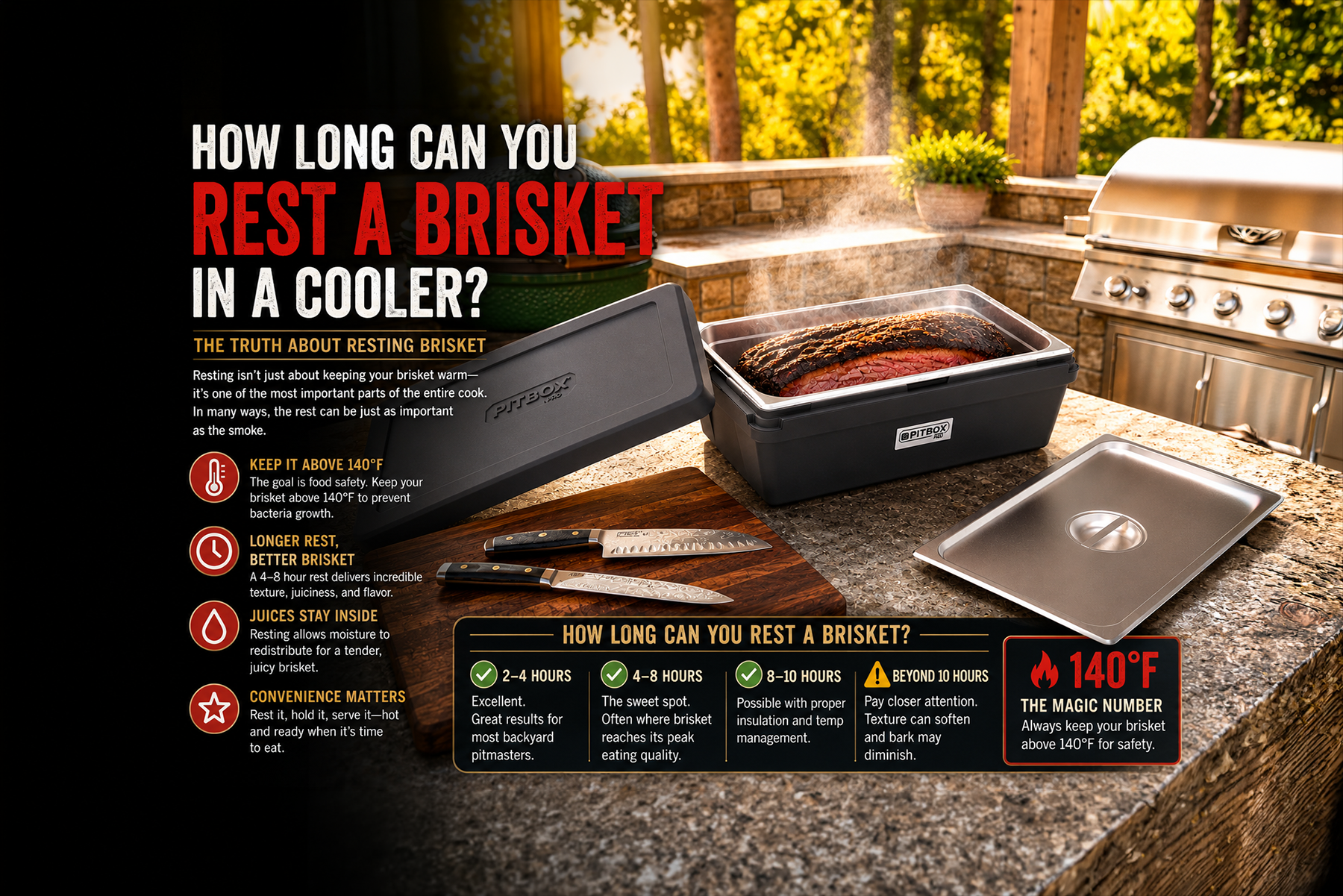
One of the most common questions I hear from backyard pitmasters is:
"How long can you rest a brisket in a cooler?"
The short answer is: longer than most people think.
I've personally rested briskets in traditional coolers for around three hours with great results. But after years of cooking and extensive testing while developing PITBOX™, I've learned that resting isn't just about keeping a brisket warm—it's one of the most important parts of the entire cook.
In many ways, the rest can be just as important as the smoke.
My Experience Resting Briskets in Coolers
Like many BBQ enthusiasts, I spent years using the traditional method:
- Pull the brisket from the smoker
- Wrap it in butcher paper or foil
- Add towels
- Place it in a cooler
And honestly, it works.
I've rested briskets for approximately three hours in coolers and served some excellent meals. The brisket stayed hot, remained juicy, and gave me flexibility when guests were arriving.
But over time, I realized the cooler method had limitations.
Most coolers weren't designed for hot food. They were designed for cold beer & ice.
Eventually the cooler becomes stained, develops odors, and often gets permanently dedicated to BBQ duty. Once you've soaked a cooler with brisket juices a few times, most people aren't excited about putting drinks back into it. And I am certain no one likes tossing their "meat towels" in the washing machine with your clothes.
Those are a few of the reasons I started looking deeper into the science and practicality of resting meat.
The Difference Between a 3-Hour Rest and a 7-Hour Rest
During testing, I began experimenting with significantly longer holding times.
One of the most eye-opening tests involved resting a brisket for nearly seven hours.
The result surprised me.
The brisket wasn't just hot...it was incredible!
The texture was relaxed. The juices had fully redistributed. The slices held together beautifully while remaining tender. The eating experience felt more refined and more forgiving than many briskets I'd served after shorter rests.
The biggest lesson?
A properly rested brisket can continue improving long after it leaves the smoker.
Most pitmasters focus on getting to 205°F internal temperature.
Experienced pitmasters know that's only part of the journey.
Why Resting Matters So Much
When a brisket comes off the smoker, the muscle fibers are still tight and full of energy from the cooking process.
Resting allows:
- Internal temperatures to equalize
- Moisture to redistribute
- Connective tissue to continue relaxing
- Texture to become more uniform
That's why many competition teams and experienced pitmasters build their entire cooking schedule around the rest.
They're not rushing from smoker to slicing board. They're planning for the hold.
If you're into the science, check this video out from our friend, Steve Gow at SMOKE TRAILS BBQ. He knows a thing or two on the subject.
• RESTING VIDEO
• RESTING MASTERCLASS
• REST CALCULATOR
So How Long Can You Rest a Brisket?
Here's my practical answer:
2–4 Hours
Excellent. This is where many backyard cooks operate and you'll get fantastic results.
4–8 Hours
In my experience, this is where brisket becomes extremely forgiving and often reaches its peak eating quality.
8–10 Hours
Possible with proper insulation and temperature management. I've seen outstanding results in this range. Rest a brisket this long correctly, watch this video from Mad Scientist BBQ
Beyond 10 Hours
This is where I'd start paying closer attention. Depending on the holding temperature, texture can eventually begin to soften too much and bark quality may diminish.
Can it still be great? Absolutely. But there is a point where "longer" doesn't automatically mean "better."
The Food Safety Factor
Quality and safety are two different conversations.
The goal is always to keep the brisket above 140°F.
If you can safely maintain temperatures above 140°F, you have significantly more flexibility than most people realize.
This is one reason restaurants and professional kitchens often use heated holding equipment rather than serving immediately after cooking.
They understand that controlled holding can be an advantage, not a compromise.
What I Learned While Developing PITBOX™
When I started designing PITBOX™, I wasn't just trying to build something that held temperature longer.
I was trying to solve the frustrations that came with using coolers.
I wanted something that was:
- Purpose-built for resting meat
- Easy to clean
- Dishwasher safe
- Don't ruin your cooler with odors and stains
- Designed specifically for hot food rather than ice
As a Type 1 diabetic, I also spend a lot of time thinking about the food I ingest, carbs, safety and sanitation. The idea of placing a fresh brisket into a plastic cooler that had spent years holding ice, drinks, bait, camping gear, or tailgate supplies never felt like the ideal solution.
Temperature retention was important. But cleanliness and purpose-built design were equally important.
My Personal Sweet Spot
If I'm cooking for family or friends, my ideal brisket rest is usually around 4–6 hours.
That window gives me tremendous flexibility.
Instead of staying up all night trying to perfectly time a brisket for dinner, I can finish the cook earlier, let the brisket rest properly, and enjoy the day.
Ironically, the longer rest often produces a better brisket and a better experience for the cook.
Final Answer: How Long Can You Rest a Brisket in a Cooler?
Most people can comfortably rest a brisket in a well-insulated cooler for 2–4 hours.
With proper insulation and temperature management, holding times of 6–10 hours are absolutely achievable.
The real surprise is that longer rests often improve the final product.
After years of cooking briskets and testing holding methods, I've become convinced that one of the biggest mistakes backyard pitmasters make is slicing too soon.
The next time you cook a brisket, don't just focus on the smoke.
You own the cook, now you can Own The Rest™
Share:
Let Your Cooler Do Its Real Job
The ONE Thing Every Backyard Pitmaster Gets Wrong About Brisket